Key Takeaways
Here are the facts to know about the Houston region this month
Takeaway #1
Houston’s suburbs are becoming more diverse. Fort Bend now edges out Harris County as the most racially and ethnically diverse in the region with the highest share (30.7 percent) of foreign-born residents, including a majority from Asia.
Takeaway #2
Most Houston-area counties skew younger than the nation (median age 39.2). Liberty is the youngest, with a median age of 33.7 and the largest share of residents under 18 years old (30.7%).
Takeaway #3
Chambers County stands out with the region’s second-highest median income, supported by relatively strong associate-degree attainment and high-paying jobs in chemical manufacturing and oil refining.
COMPARING HOUSTON'S COUNTIES
In the October issue of Houston: The Economy at a Glance, the Partnership explored how the region’s demographic and economic profile has evolved over the past decade, drawing on newly released American Community Survey (ACS) data for ’24 from the U.S. Census Bureau. In short, the region has grown more diverse and better educated while aging more slowly than the nation overall.
The November issue examined the same data through a wider lens, comparing Houston with the nation’s other major metros. That analysis showed the typical Houston worker had higher purchasing power than most peers nationwide. It also reinforced Houston’s profile as one of the country’s most ethnically diverse metros with a large foreign-born population, while showing that Houston is the youngest major metro in the country. Houston ranked near the middle of the pack for labor force participation, but trailed its peers in educational attainment, health insurance coverage, and the share of families living in poverty.
In this issue of Glance, the Partnership turns its focus inward to examine the economic and demographic differences among the 10 counties that make up the Houston metropolitan region. Most of the analysis that follows draws on ‘24 1-year ACS estimates, but for the three smallest counties (Austin, Chambers, and San Jacinto) where 1-year data are not available—we rely on the most recent 5-year estimates from ’23 instead.
Race and Ethnicity
Although Houston is one of the nation’s most racially and ethnically diverse metros, populations are far from evenly distributed across its counties. Harris and Liberty counties each have large Hispanic pluralities, with Hispanic residents accounting for just under half of the population in both. Several counties in the region, including Galveston, Montgomery, Austin, Chambers, and San Jacinto, remain majority non-Hispanic White. Fort Bend and Waller counties have the region’s highest shares of Black residents, and Fort Bend stands out further with by far the largest share of Asian residents in the metro.
One way to measure diversity between counties is to calculate a Simpson Diversity Index which gives the probability that two randomly selected residents will belong to different racial/ethnic groups. The table below reports the index for each of metro Houston’s counties.
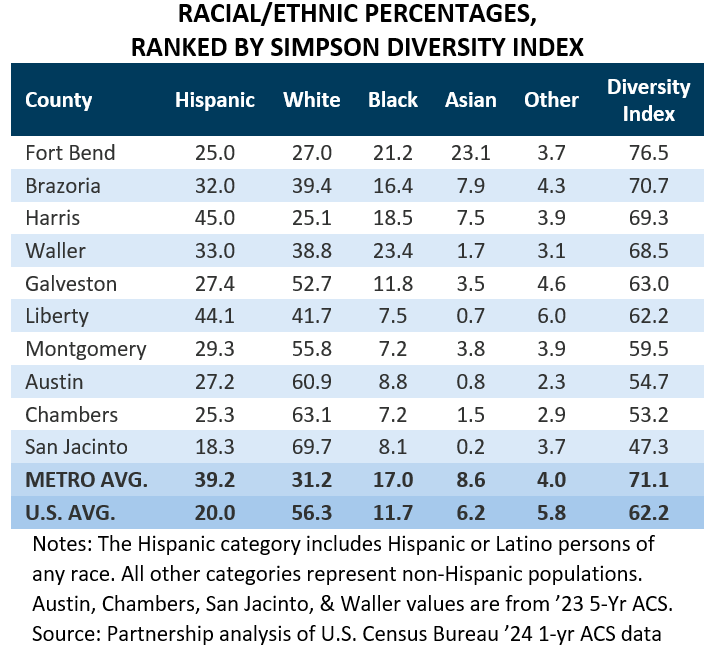
Fort Bend stands out as the region’s most diverse county, as well as one of the most diverse in the nation, with relatively even representation across major racial/ethnic groups. Brazoria ranks second, edging out Harris County, with comparatively larger shares of non-Hispanic White, Asian, and residents belonging to other racial/ethnic groups. These two suburban counties underscore a broader pattern: Much of the region’s growth and diversification is now occurring outside the central core, as suburban communities become increasingly multiethnic – shaped by domestic migration, immigrant settlement, and second-generation households.
Foreign-Born Population
More than one-in-four Houstonians (25.4 percent) were born outside the United States – far higher than the national rate of one-in-seven (14.8 percent). Fort Bend and Harris Counties together are home to 86.7 percent of the region’s foreign-born residents. While Harris County has the largest foreign-born population in absolute terms, Fort Bend leads on concentration, with nearly one-in-three residents born abroad. And while Latin America is the largest region of origin in the other nine counties, Fort Bend stands out, with a majority (50.7 percent) of its foreign-born residents coming from Asia.
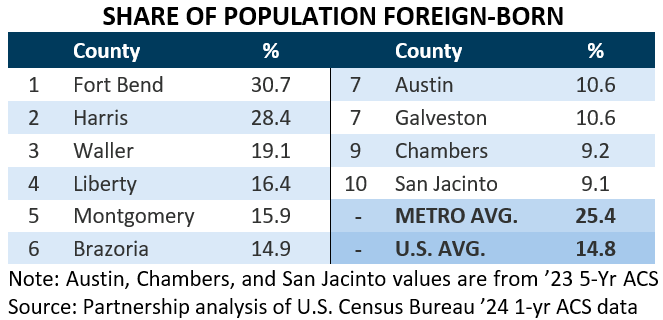
Across metro Houston’s 10 counties, a majority have foreign-born shares above the national average, reflecting how immigrants are integral to the region’s urban core while becoming increasingly central to its fast-growing suburbs.
Languages Spoken
With such a large share of Houston’s population born outside the U.S. its no surprise that much of the population speaks a language other than English at home. In Harris County, that share is nearly twice the national average, while in Fort Bend, Liberty, and Waller, more than one-in-three residents speak a language other than English.
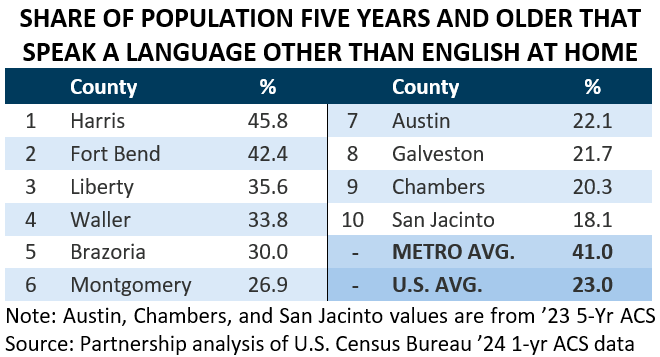
Approximately 145 languages are spoken across the metro area. After English, Spanish was by far the most common language with 30.2 percent of residents using it at home. Asian or Pacific Islander languages (such as Vietnamese or Chinese) are spoken by 5.2 percent of the population, followed by other Indo-European languages at 3.6 percent.
Note: The geographic area referred to in this publication as “Houston,” "Houston Area” and “Metro Houston” is the ten-county Census designated metropolitan statistical area of Houston-Pasadena-The Woodlands-Sugar Land, TX. The ten counties are: Austin, Brazoria, Chambers, Fort Bend, Galveston, Harris, Liberty, Montgomery, San Jacinto, and Waller.
To continue reading, please download the full report below: