Key Takeaways
Here are the facts to know about the Houston region this month
Takeaway #1
The typical Houston worker enjoys some of the strongest purchasing power in the country, with median earnings of nearly $50,000 after adjusting for the local cost-of-living.
Takeaway #2
Houston remains one of the nation’s most diverse metros in the nation, with a 71.1 percent chance that any two randomly selected residents will come from different racial or ethnic groups.
Takeaway #3
Houston is also the youngest major U.S. metro, with a median age of 35.7 and more than one-quarter of residents under 18, helping ensure a steady talent pipeline to fuel growth in the years ahead.
HOW HOUSTON STACKS UP
In the October issue of Houston: The Economy at a Glance, the Partnership explored how the region’s demographic and economic profile has evolved over the past decade, drawing on newly released American Community Survey (ACS) data for ’24 from the U.S. Census Bureau. In short, the region has grown more diverse and better educated while aging more slowly than the nation overall. Additionally, the share of foreign-born residents has increased, with those born abroad now accounting for more than one in four Houston residents.
In this issue of Glance, the Partnership uses the latest ACS data to compare Houston with the nation’s 20 largest metro areas, to see how the region stacks up. The results highlight the region’s strengths, shed light on its challenges, and underscore Houston’s capacity for continued progress and growth.
Worker Earnings
The median worker in Houston earned $45,984 per year in ‘24, placing the region 17th among the nation’s 20 most populous metros. On the surface, that figure suggests the typical Houston worker is worse off than counterparts in most other large metros, but the comparison does not account for regional differences in the cost-of-living.
According to the Council for Community and Economic Research (C2ER) Cost of Living Index (COLI), Houston was the 2nd most affordable major metro in ‘24, with overall costs falling 5.8 percent below the U.S. urban average. When wages are adjusted to reflect what they would be if living costs matched the national average, the typical Houston worker’s purchasing power rises to $48,815 per year. That is enough to propel Houston to the no. 6 spot near the top of the list.
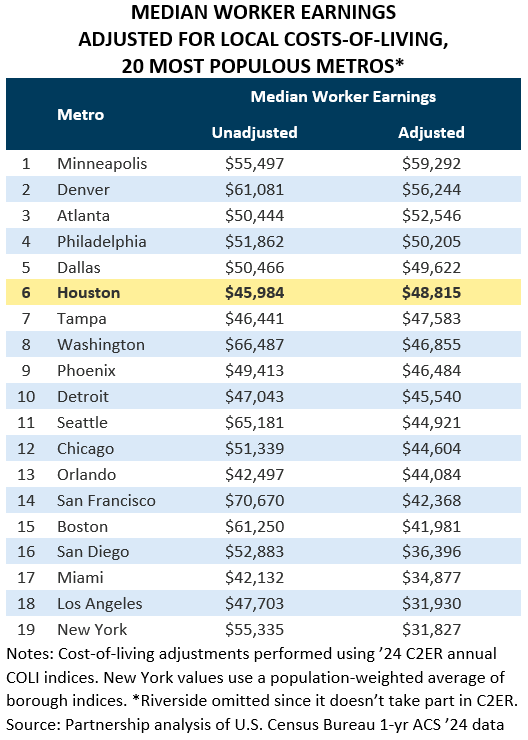
Many of the nation’s largest coastal metros, such as New York and Los Angeles, drop sharply in the rankings once cost-of-living differences are taken into account. Although workers in those regions tend to earn higher nominal wages, their earnings are quickly eroded by steep housing, transportation, and everyday living costs. The result is that the typical worker in a high-cost coastal market has far less real purchasing power than a worker in Houston, underscoring how affordability is as critical as income in shaping a worker’s overall economic well-being.
Race and Ethnicity
Houston is among the most racially and ethnically diverse metro regions in the United States. As has been the case since the turn of the century, no single racial or ethnic group makes up a majority of the local population. Instead, Houston’s demographics reflect a broad mix of people that bring an inclusive character to its culture.
One way to measure a region’s diversity is through the Simpson Diversity Index, which shows the odds that two randomly selected residents in a region will belong to different racial or ethnic groups. Dividing the population into Hispanic or Latino residents of any race and non-Hispanic White, Black, Asian, and other residents (including those of two or more races), Houston ranks fourth for diversity, with a 71.1 percent chance that any two random people will have different racial or ethnic backgrounds.
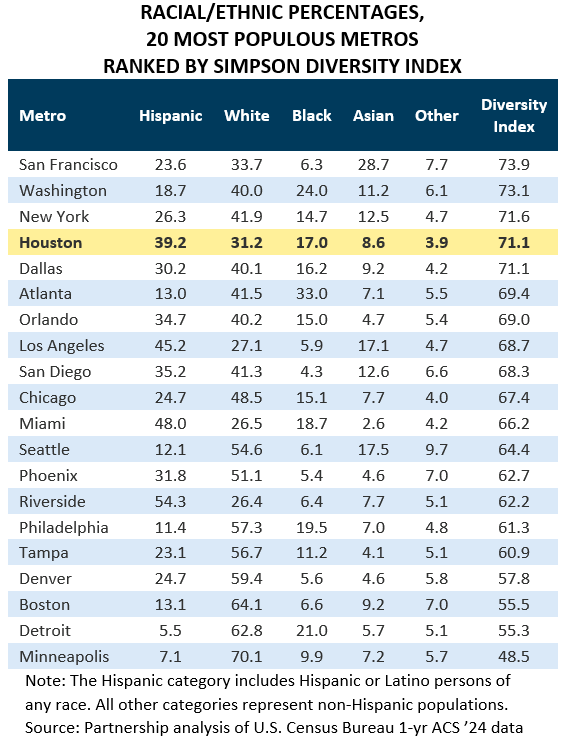
The three metros ranking above Houston are only slightly more diverse. In top-ranked San Francisco, the odds that two random residents belong to different groups are just 2.8 percentage points higher than in Houston.
In contrast to Houston, a single racial/ethnic group forms the majority of the population in the bottom nine metros on the list. In eight (Seattle, Phoenix, Philadelphia, Tampa, Denver, Boston, Detroit, and Minneapolis), the majority is non-Hispanic White, while in Riverside, Hispanic or Latino residents make up most of the population.
Note: The geographic area referred to in this publication as “Houston,” "Houston Area” and “Metro Houston” is the ten-county Census designated metropolitan statistical area of Houston-Pasadena-The Woodlands-Sugar Land, TX. The ten counties are: Austin, Brazoria, Chambers, Fort Bend, Galveston, Harris, Liberty, Montgomery, San Jacinto, and Waller.
To continue reading, please download the full report below: