Artificial intelligence has moved rapidly into the workplace, taking on writing, coding and analysis that once required the skills of highly trained professionals. It promises a major boost to productivity, but its growing capabilities have also fueled concerns about widespread job displacement. So far, labor market data has offered few clear signals. Some studies find early signs of weaker hiring among young workers in certain fields, while others point to productivity gains that could eventually spur job creation. Although widespread job losses remain speculative, a consensus is emerging that AI has greater potential to reshape some occupations than others.
To better understand where AI could have the greatest impact, researchers at OpenAI developed an exposure score estimating what share of an occupation’s regular tasks an AI could help complete substantially faster or potentially perform on its own.
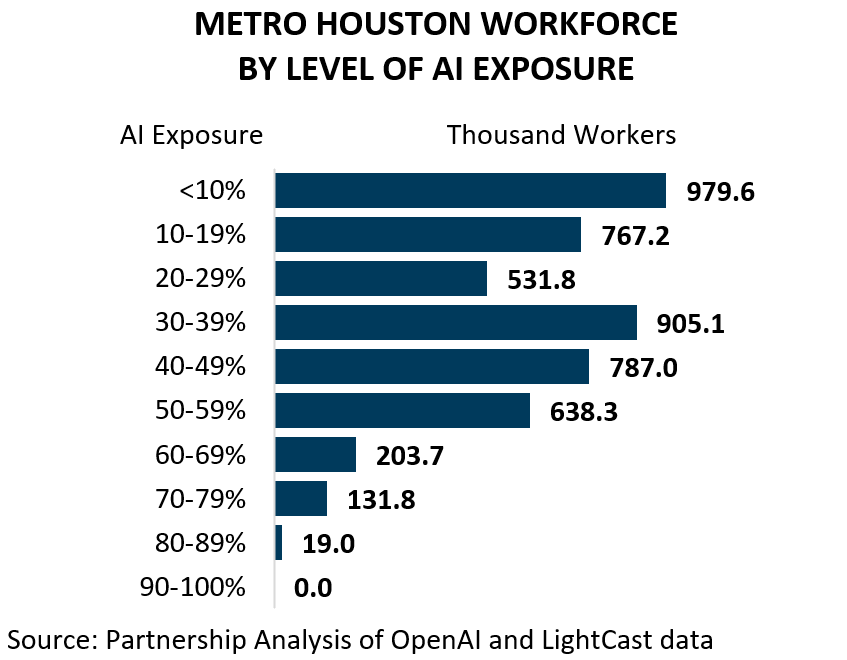
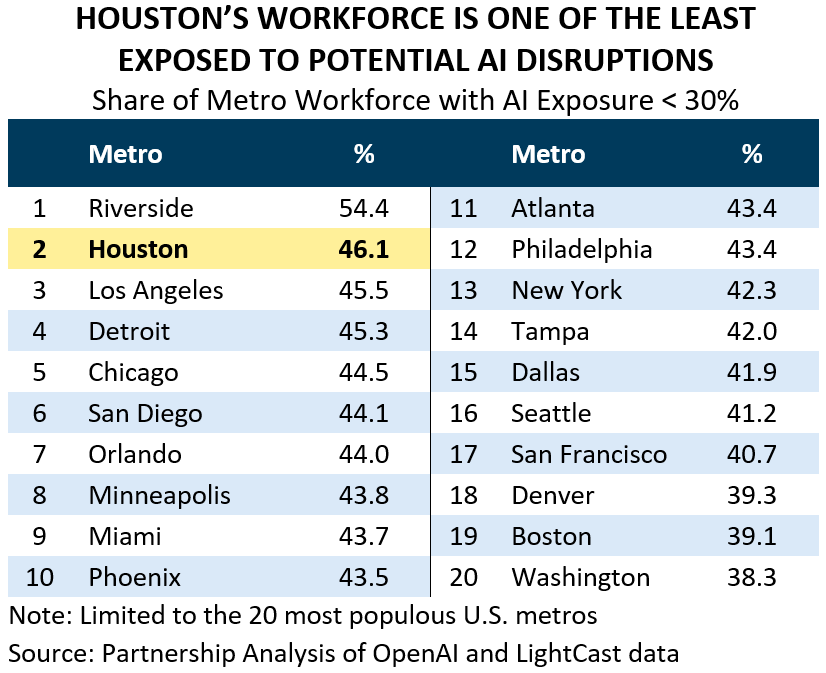
Applying these scores to metro Houston’s roughly five million workers (including payroll workers and the self-employed) reveals a workforce with relatively limited exposure. Nearly 2.3 million workers, or 46.1 percent of the total, have exposure scores below 30 percent. That includes almost one million with scores under 10 percent, reflecting the region’s sizable concentration of work that relies on physical interaction, hands-on experience and specialized technical skills.
Houston stands out among major U.S. metros for its relatively low exposure to AI. Of the nation’s 20 most populous, only Riverside, California, has a larger share of workers with exposure scores below 30 percent. Houston’s distinctive industry mix helps explain why. Energy, manufacturing, construction and health care support occupations combining specialized technical expertise with hands-on responsibilities, making many tasks harder to automate than the office-based work more prevalent elsewhere.
And for Houston’s more exposed workers, AI may offer as much opportunity as risk. The region specializes in occupations like engineering and health science, where AI could accelerate research, design and analysis, but much of the work still depends on physical tasks, personal interaction and human accountability. These roles are difficult to automate entirely, even when individual tasks can be completed much faster. For these workers, AI may prove more of a force multiplier than a replacement.