Key Takeaways
Here are the facts to know about the Houston region this month
Takeaway #1
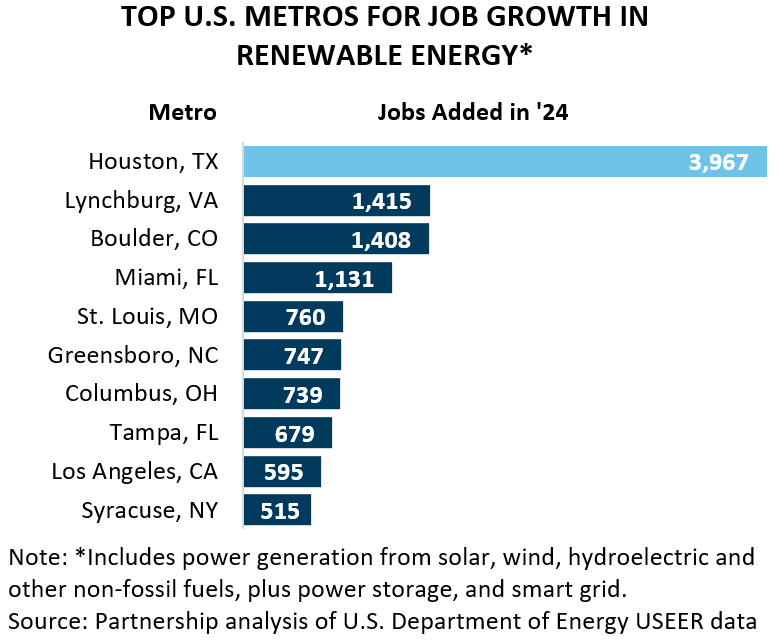
With an estimated 3,967 workers added in '24, renewable energy represented roughly one-in-twelve new jobs in the region.
Takeaway #2
Solar power accounted for most of this growth, with the solar workforce growing by 45.4 percent year-over-year.
Takeaway #3
With over 8,000 workers, Houston bests all other metros as the top national employer in wind power.
RENEWABLE ENERGY CAPITAL OF THE NATION?
The U.S. Department of Energy released its 2025 U.S. Energy & Employment Report (USEER) in late August, providing invaluable data on employment trends across the energy sector.
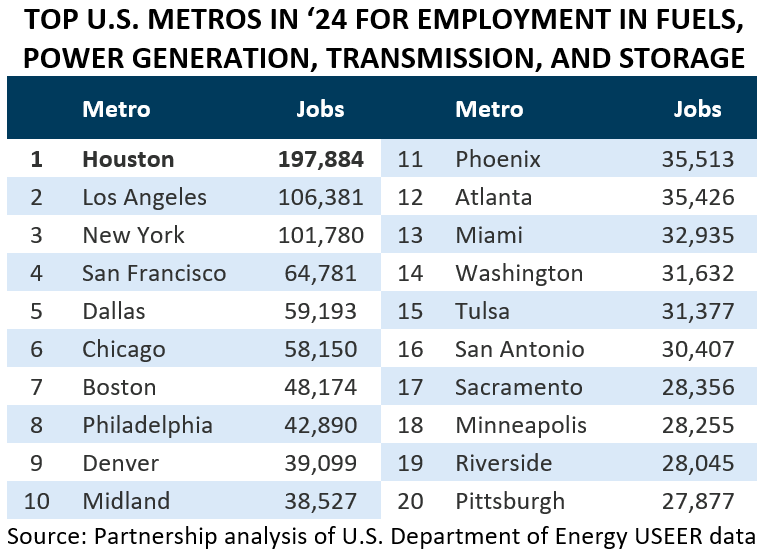
It should come as no surprise that the data shows Houston remains the energy capital of the nation, leading all other metros with almost 200,000 people employed in producing fuels, power generation, transmission, distribution, and storage. This puts Houston significantly ahead of major coastal metros like New York or Los Angeles, which employ just over 100,000 workers each.
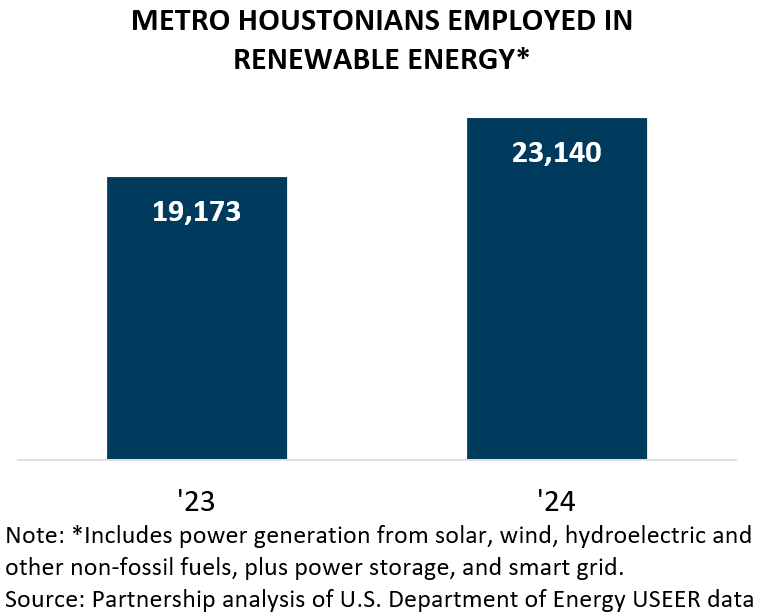
While most of this workforce is involved in conventional fuels and modes of power transmission, employment in renewable energy has grown rapidly. Year-over-year, the number of people employed in renewable energy (defined here to include solar, wind, hydroelectric and other non-fossil fuel forms of power generation, plus power storage and smart grid transmission) grew by 20.7 percent from 19,173 workers in ’23 to 23,140 in ’24. Renewable energy jobs now make up nearly 12 percent of metro Houston’s broader fuel, power generation, transmission, and storage sector.
Houston’s renewable energy sector is by far the fastest growing in the nation as measured by employee headcount. With 3,967 new jobs, Houston added almost three times as many workers to its renewable energy labor force as the runner-up metros of Lynchburg, VA, or Boulder, CO.
Of the region’s 49,500 total jobs added in ’24, renewable energy represents 8.0 percent of all job growth. That means that roughly one-in-twelve new jobs created in Houston last year was in renewable energy. It produced slightly fewer jobs than sectors like construction (5,000 jobs) or wholesale (4,200 jobs) but more than other major sectors like retail (2,700 jobs) or restaurants and bars (1,700 jobs).
Note: The geographic area referred to in this publication as “Houston,” "Houston Area” and “Metro Houston” is the ten-county Census designated metropolitan statistical area of Houston-Pasadena-The Woodlands-Sugar Land, TX. The ten counties are: Austin, Brazoria, Chambers, Fort Bend, Galveston, Harris, Liberty, Montgomery, San Jacinto, and Waller.
To continue reading, please download the full report below: