
Houston’s economic competitiveness depends on how employers choose to invest in people. Talent is our future, which is why Talent and Economic Mobility is one of the Greater Houston Partnership’s strategic imperatives.
The inaugural Talent Forward Summit brought together employers, educators and workforce leaders to explore how we can shape Houston’s talent future – with more than 20 speakers across more than 10 industries participating in the conversation. As global trends reshape the workplace, the stakes could not be higher. Deloitte’s 2025 Global Human Capital Trends report found that over 70 percent of workers and managers believe organizations should do more to help employees build real-world experience. In the same report, 78 percent of workers understand what motivates them, but only a third strongly believe their organizations and managers understand their motivations.
Here are five takeaways as Houston looks to become a global leader in talent development and economic mobility.
1. People-First Culture Drives Retention
Speakers from WM, H-E-B, and Bank of America underscored that competitive pay is not enough. Employees stay where they feel valued, supported and connected to the company’s mission. Building inclusive, people-first cultures with accountability and transparency remains essential to retaining and motivating talent.
“It’s not money that causes people to leave, it’s that they don’t feel valued. You have to make people feel like they’re valued,” WM CEO Jim Fish said. “That’s the cultural shift we’ve made at WM.”
2. Creating Talent Pipelines through Partnerships
Collaboration between industry and educational institutions is essential to building Houston’s future workforce.
“We cannot solve today’s workforce challenge with yesterday’s solution. The new model calls on employers to partner with higher education to support hands-on learning through mentorships, college and support,” said Amy Patton, director of early career talent acquisition at LyondellBasell. “We can no longer be the customers of talent. We must be the co-creators to solve this together.”
LyondellBasell’s partnership with San Jacinto College (SJC) on the Center for Petrochemical, Energy, and Technology (CPET) has been successful since its launch in 2019, offering industry-leading training that enables students to earn associate’s degrees and certificates. Many graduates have earned over $100,000 within approximately four years of entering their industry. SJC used that same model to establish the recently opened Center for Biotechnology at Generation Park. Both programs are strong examples of how industry-education partnerships are shaping an inclusive and resilient workforce for Houston.
Aon is also demonstrating the power of apprenticeships through its program in nine U.S. cities, including Houston, which creates structured, skills-based pathways into careers that don’t require traditional degrees. One program graduate, now an environmental broker, credited mentorship and training with helping him “trust the process” and see the payoff of hard work.
3. Skills-Based Hiring Unlocks Mobility
Skills-based hiring isn’t just good for workers – it delivers clear returns for companies. By widening the lens beyond traditional degrees and credentials, employers tap into larger, more diverse talent pools while reducing time-to-hire and turnover costs. Just as important, investing in internal skills development boosts productivity and retention, helping companies maximize the value of their existing workforce.
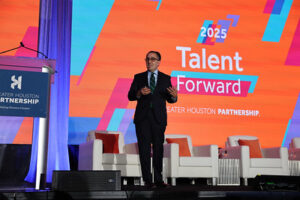
Victor Reyes, managing director at Deloitte, noted that 66 percent of leaders say recent hires lack needed skills – highlighting the urgency of new approaches. Companies that invest in people’s skills experience higher engagement and performance, demonstrating that workforce development not only fosters economic mobility but also provides a business advantage.
Worley is a prime example, offering apprenticeships, mentorships, and partnerships with Channelview High School that align skills-based hiring with industry-education collaboration.
4. AI is Reshaping Work, Demands Inclusive Design
Across sectors, leaders acknowledged both the promise and tension of artificial intelligence. AI can enhance performance and creativity, but also risks eroding autonomy and trust if not implemented carefully.
The message was clear: inclusion must be built into AI systems from the start to ensure technology supports people, not replaces them.
Alveda Williams, Chief Inclusion Officer at Dow, shared how the company is taking a “deliberate, enterprise-wide approach” to incorporating AI, making it a capability all employees can use.
5. Houston is Building the Future of Connectivity
The Summit also marked the announcement of the conceptual framework for the Connectivity Platform, an AI-powered career navigation and workforce development system that will be designed for the Houston region. By harnessing data and generative AI, the platform aims to make Houston the national model for how regions align talent supply with demand.