The Partnership sends updates for the most important economic indicators each month. If you would like to opt-in to receive these updates, please click here.
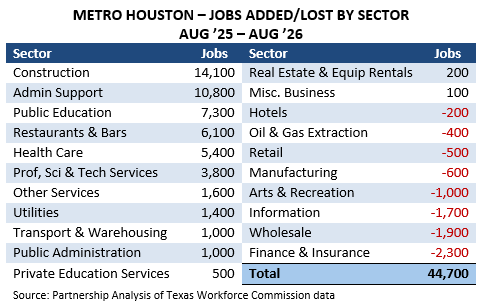
Metro Houston created 17,500 jobs in ’25, according to benchmark revisions released by the Texas Workforce Commission (TWC). That is stronger than the agency’s initial estimate of 14,800 jobs. The revised figures suggest Houston’s economy grew at a more robust pace last year than previously believed, as sizable upward revisions in construction, administrative support, and professional, scientific, and technical services more than offset weaker readings in sectors like oil and gas extraction and restaurants and bars.
The revised estimates are the result of the annual benchmark revision process that TWC undertakes to improve the accuracy of its estimates. The monthly jobs reports that TWC releases throughout the year are based on a sample of local employers responding to the agency’s employment survey. Like all surveys, it is subject to sampling, non-response, and processing error. Every spring, TWC revises its survey estimates by benchmarking them against the state’s comprehensive record of unemployment insurance filings. The result is a clearer and more reliable picture of job growth in Houston and across Texas.

Construction saw the largest upward revision, with job growth in ’25 revised from 2,300 to 13,600. That made it Houston’s top sector in terms of jobs added last year, outpacing health care, as hiring tied to infrastructure projects and specialty contractors came in much stronger than initially estimated. Administrative support also shifted sharply higher, moving from a reported loss of 7,300 jobs to a gain of 3,200. That reflected stronger-than-estimated growth in building services, including janitorial staff and maintenance workers, and smaller-than-estimated losses in employment services, such as temporary staffing and recruiting firms. Professional, scientific, and technical services was also revised meaningfully higher. Job losses narrowed from 9,100 to 2,400, suggesting the effects of last year’s pullback in external business spending were less severe than first thought.
Thirteen of the 21 sectors tracked by the Greater Houston Partnership were revised downward, though most of those changes were modest. In nine sectors, the revisions were smaller than 2,500 jobs, but four sectors saw more meaningful adjustments. Oil and gas extraction shifted from a gain of 1,900 jobs to a loss of 3,500 as lower oil prices in ’25 reduced drilling and exploration activity. Restaurants and bars were revised from a gain of 4,900 jobs to flat employment, suggesting softer consumer spending and weaker hiring than initially reported. Transportation and warehousing was revised from a gain of 3,900 jobs to 700, as growth in warehousing came in below early estimates. Retail moved from a gain of 700 jobs to a loss of 2,400, reflecting a steeper-than-expected drop-off after the ’24 holiday shopping season and a smaller seasonal build in November ’25.
The benchmark revisions show Houston’s job growth rate in ’25 was 0.5 percent, up from the initial estimate of 0.4 percent. That still falls below the region’s long-term average of roughly 1.5 percent, reflecting a national macroeconomic environment that was marked by greater uncertainty and slower hiring. Even so, Houston outperformed the rest of the nation by a wider margin than first reported: at 0.5 percent, the region’s job growth rate was more than ten times higher than the national rate of 0.04 percent.

Alongside the ’25 benchmark revisions, TWC also released January ’26 employment estimates showing that metro Houston shed 41,000 jobs during the month. Seasonal job losses of that magnitude are typical as temporary holiday employment winds down and education positions tied to the fall semester taper off. This year’s drop of 41,000 was smaller than usual, with January averaging a decline of roughly 46,000 jobs over the past decade.

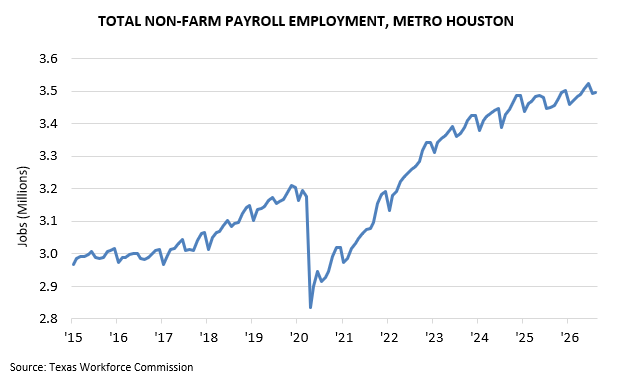
Total non-farm payroll employment for the region now stands at 3,461,900.
Prepared by Greater Houston Partnership Research Division.
Colin Baker
Manager of Economic Research
Greater Houston Partnership
[email protected]