

The Partnership sends updates for the most important economic indicators each month. If you would like to opt-in to receive these updates, please click here.
Estimated Read Time: 2 minute
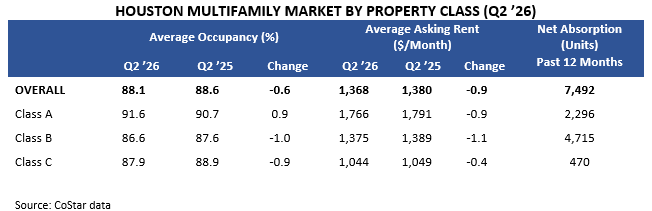
The multifamily market in Metro Houston remained relatively stable in Q2/26, although occupancy and average rent was modestly lower than a year earlier. Overall occupancy declined to 88.1 percent from 88.6 percent in Q2/25, while the average asking rent decreased to $1,368 from $1,380. The market absorbed 7,492 units over the past 12 months, led by Class B properties, with additional gains in Class A and Class C. Despite the positive absorption, ongoing additions to inventory kept occupancy and rents slightly below year-earlier levels. At the end of the quarter, 13,066 units were under construction, and 4,719 units were delivered during Q2.
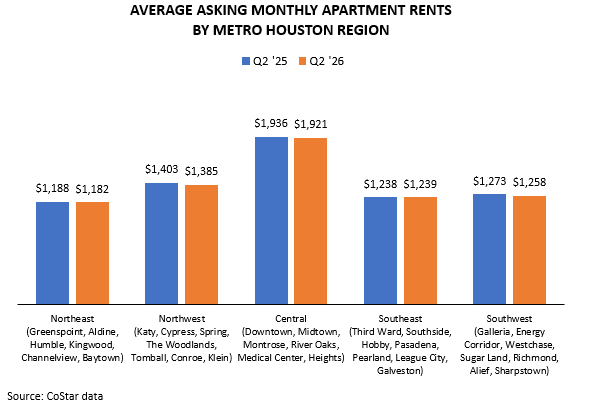
Average asking rents changed modestly across Metro Houston over the past year. The Southeast was the only region to record an increase, edging up to $1,239 per month from $1,238 in Q2/25. Rents declined slightly in the Central, Northwest, Southwest, and Northeast regions. At $1,182 per month, the Northeast remained the most affordable of the five regions shown.
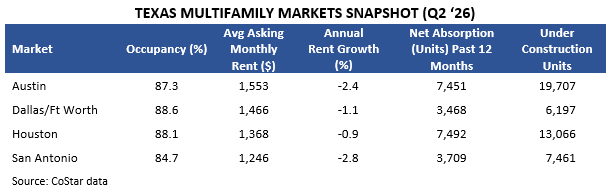
Across major Texas metros, multifamily conditions softened over the past year, with each market recording lower rents and occupancy. Houston experienced the smallest annual rent decline at 0.9 percent and recorded the highest 12-month absorption among the four markets. Average asking rents in Houston remained approximately 12 percent below Austin and 7 percent below Dallas–Fort Worth.
Prepared by Greater Houston Partnership Research Department


Want to learn more? Contact our Research Team:
Leta Wauson
Director, Research
Greater Houston Partnership
lwauson@houston.org
Miles Nicchio
Intern, Research
Greater Houston Partnership
mnicchio@houston.org