

The Partnership sends updates for the most important economic indicators each month. If you would like to opt-in to receive these updates, please click here.
Estimated Reading Time: 3 minutes
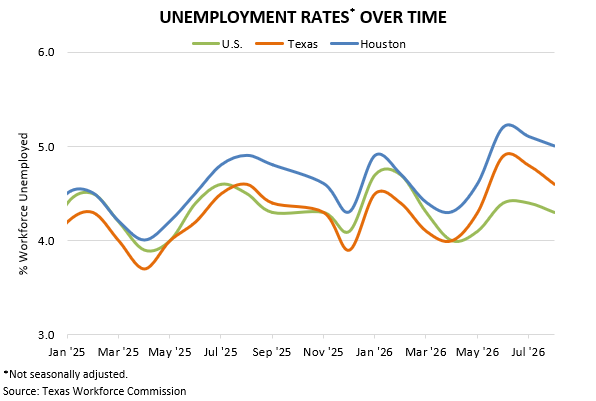
Metro Houston’s unemployment rate edged down to 5.0 percent in August from 5.1 percent in July and was little changed from 4.9 percent a year ago. The decline is typical for late summer as recent graduates begin finding work. Houston’s rate remains above the Texas and U.S. rates of 4.6 percent and 4.3 percent, respectively, in part because the region has a faster-growing labor force and is adding new job seekers faster than employers can absorb them. Initial unemployment claims remain near their lowest level of the year, pointing to limited layoff activity.
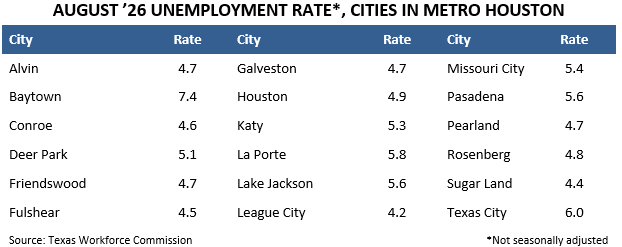
Across the Houston area, unemployment varied widely by city. Among the 18 Houston-area cities where data are reported, unemployment rates ranged from 4.2 percent to 7.4 percent. Ten cities posted rates below the metro average: Alvin, Conroe, Friendswood, Fulshear, Galveston, Houston, League City, Pearland, Rosenberg, and Sugar Land. The remaining eight cities, Baytown, Deer Park, Katy, La Porte, Lake Jackson, Missouri City, Pasadena, and Texas City, reported higher unemployment rates.
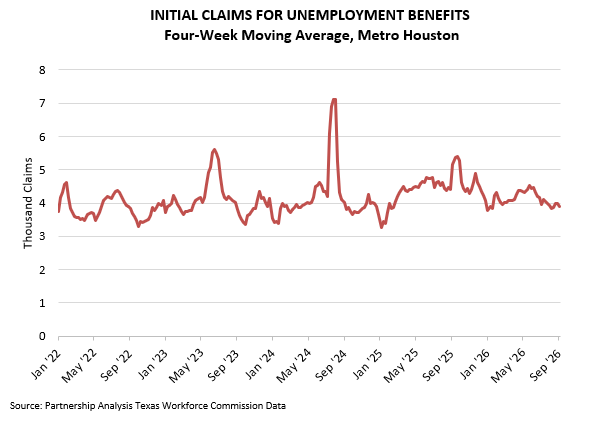
Initial unemployment claims have continued to decline and are near their lowest level of the year, with the four-week moving average at 3,883 in early September, just above the 3,786 recorded in the first week of January. Claims have declined steadily from a late-May peak of 4,520, pointing to easing layoff pressure this summer.
Prepared by Greater Houston Partnership Research Division.
Colin Baker
Director of Economic Research
Greater Houston Partnership
bakerc@houston.org